Fermentation jars: a practical sauerkraut guide
A little sauerkraut can go into a sandwich or sit alongside a salad or an omelette. You do not need several full jars to get started. Choose a batch you can keep an eye on and make room for it in the fridge first. This guide explains the equipment, the order of work and the difference between fermenting vegetables and adding vinegar.
Products to compare in this guide
Exterior dimensions and capacities as stated by each manufacturer; they do not replace the free space in your cupboard. Sorted by location and width, unrelated to commission.
amazon.co.uk · Affiliate link: Cubifora may earn a commission on purchases that meet the applicable requirements.
| Model | Location | Width | Depth | Height | Stated capacity | Compartments | Fixing type | View on Amazon |
|---|---|---|---|---|---|---|---|---|
| Kilner 0025.839: 3 L fermentation set | No documented data | 17 cm | 17 cm | 32 cm | 3 L | No documented data | No documented data | View on Amazon |
| Kilner 0025.010: two 1 L fermentation jars | No documented data | No documented data | No documented data | No documented data | 1 L | No documented data | No documented data | View on Amazon |
Decide between vinegar pickles and lactic acid fermentation
For vinegar pickles, the recipe supplies acid through the vinegar. During lactic acid fermentation, bacteria turn vegetable sugars into acid. Cabbage and salt are the basis of sauerkraut; the word «lactic» does not mean adding milk [1].
Refrigerator pickles need a recipe designed for that method and must stay chilled. Vinegar added to taste is not enough: its stated acidity and the ratio of vinegar, water and vegetables matter. A recipe specifying vinegar with 5% acidity is not a place to use homemade vinegar of unknown strength or extra water to soften the flavour [2, 6]. The worked example here is fermented cabbage; use a tested recipe for other vegetables.
Two Kilner sets for different batch sizes
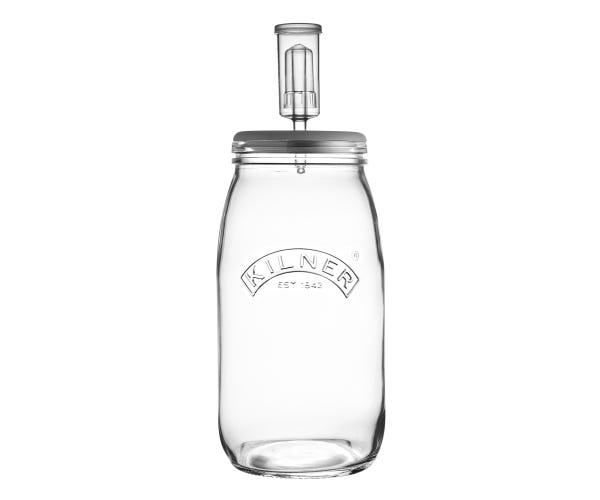
The Kilner 0025.839 3 litre fermentation set contains a jar, two ceramic weights, a silicone lid and an airlock. The manufacturer lists overall dimensions of 17 × 17 × 32 cm. Check where the assembled set will stand and whether you can reach the airlock without moving a full jar [8].
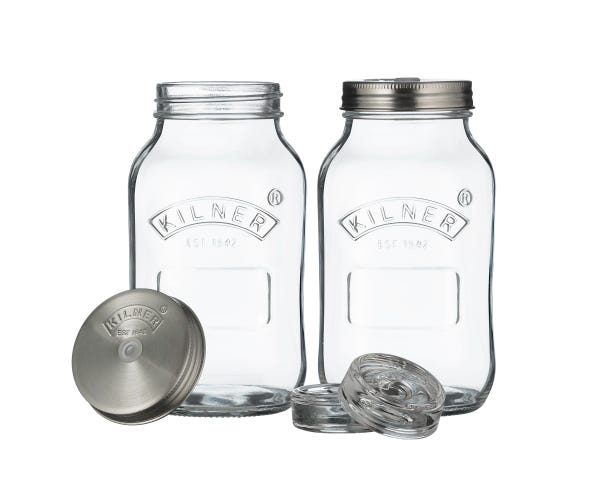
The Kilner 0025.010 set of two 1 litre jars suits smaller separate batches. It includes two glass weights and two stainless steel lids with silicone valves. Each jar has a nominal capacity of one litre; that is not a target volume of cabbage. Published set dimensions do not clearly identify individual jar dimensions, so we do not treat them as such [9].
The weight keeps vegetables below the liquid; the valve releases gas. One does not replace the other. An ordinary airtight storage jar may provide neither function. If you already own suitable equipment, check its instructions and replacement parts before buying another set.
Set out the equipment before preparing the cabbage
- Fresh, sound cabbage, canning or pickling salt, and a recipe from a reliable source. Avoid reduced-sodium salt substitutes [1].
- Scales able to measure the required salt accurately, a chopping board, knife, bowl and clean utensils.
- An undamaged food-grade jar, a compatible weight and a gas-release system, including all the small lid components.
- A spot out of direct sunlight, a thermometer and the acidity-measuring equipment specified by the recipe.
Clean hands, worktop and equipment. Remove outer leaves and damaged parts, rinse the cabbage and remove the core. Follow the care instructions for each component. Kilner says not to pour boiling water directly into these jars: cleaning and sanitising should not expose them to a sudden temperature change [8, 9].
Calculate salt using the recipe's stated basis
The University of California gives a sauerkraut example of 1,000 g of cabbage with 22.5 g of salt: 2.25% of the cabbage weight [2]. For 500 g of cabbage, the proportional calculation is 11.25 g. This illustrates that cabbage formula; it is not a universal brine for cucumbers, garlic or mixed vegetables.
Weigh the prepared cabbage and write down the salt calculation before mixing. Salt as a proportion of vegetable weight differs from salt as a proportion of water weight. A smaller jar is no reason to lower the concentration. Salt helps control the fermentation, rather than simply seasoning the result [1, 2].
Organise a first batch of fermented cabbage
- Read the complete recipe and check batch size, container, headspace and temperature first. NCHFP describes traditional sauerkraut; Oregon State covers small batches [4, 5].
- Shred the cabbage and mix with the measured salt in a clean bowl. Work it until juice is released, then transfer that liquid with the cabbage [1, 4].
- Pack down to remove gaps and fit the weight. Keep the vegetables submerged. If more liquid is needed, use the recipe's supplementary brine, rather than plain water that changes the concentration [4, 5].
- Leave the headspace required by a compatible recipe and jar system. Do not fill to the rim or copy a large crock's clearance into a small jar without checking. Resolve conflicting instructions by changing the recipe or container [4, 5].
- Assemble the lid and valve according to the manufacturer, filling the airlock with water where required. Keep the gas outlet clear. An ordinary tightly screwed lid is not a substitute during active fermentation [3, 8, 9].
- Label the batch with its start date, cabbage and salt weights, recipe and temperature. A tray underneath helps contain an overflow without moving the jar.
Follow the ferment rather than a countdown
Measure the temperature where the jar stands. NCHFP's traditional sauerkraut method uses approximately 21–24°C for about three to four weeks; small batches may follow different timings. Follow the chosen recipe's checks rather than treating that range as a deadline [4, 5].
Check submersion, valve function and acidity development. University of Minnesota guidance calls for monitoring pH and associates completion with pH 4.60 or below and bubbling having stopped [3]. Use a suitable calibrated instrument and the specified sampling method. One reading cannot repair poor handling; bubbles or a pleasant smell alone cannot establish safety.
Discard a batch without tasting if there is mould, sliminess, a rotten smell or an abnormal change. Do not skim mould off and keep the food underneath. If you cannot tell whether a surface film is spoilage, tasting it is not the way to find out [7].
Make the move to the fridge part of the plan
Once fermentation is properly complete, refrigerate according to the recipe. Set the fridge to 4°C or below, label the storage date and use clean utensils when serving [3, 10]. Storage life depends on the preparation; there is no single period for every fermented vegetable.
A fermentation lid and a final pH reading do not make a jar suitable for cupboard storage. Keeping food at room temperature requires a specific tested preservation process and suitable containers; these fermentation valves are not heat-processing lids. Start small, keep the recipe with your notes and clear a fridge shelf before preparing the cabbage.
Documentary guidance for vegetables and refrigerated storage, without hands-on product testing. Follow a tested recipe compatible with the container and its instructions; this is not a process for room-temperature storage.
Updated:
Sources consulted
- Vegetable Fermentation. FST-328P. First published 2020; expert review April 2025. — Virginia Cooperative Extension / Virginia Tech
- Not a Bushel: Small-Batch Canning for the Rest of Us. 11 June 2026. — University of California Agriculture and Natural Resources / UC Master Food Preserver
- Preserving food at home: Fermentation. Reviewed in 2026. — University of Minnesota Extension
- Sauerkraut. Adapted from USDA Complete Guide to Home Canning, revised 2015. — National Center for Home Food Preservation / University of Georgia / USDA
- Small batch sauerkraut tips. SP 50-1009. October 2025. — Oregon State University Extension Service
- Pickling vegetables. PNW 355. University extension publication. — Oregon State University / Washington State University / University of Idaho Extension
- Pickle and Pickle Product Problems. Reviewed/revised 4 December 2025. — North Carolina State University Extension
- Kilner Fermentation Set 3 Litre. Model 0025.839. Current primary product specification. — Kilner / The Rayware Group
- Kilner Set of 2 Fermentation Jars 1 Litre. Model 0025.010. Current primary product specification. — Kilner / The Rayware Group
- Are You Storing Food Safely? Consumer guidance. — US Food and Drug Administration