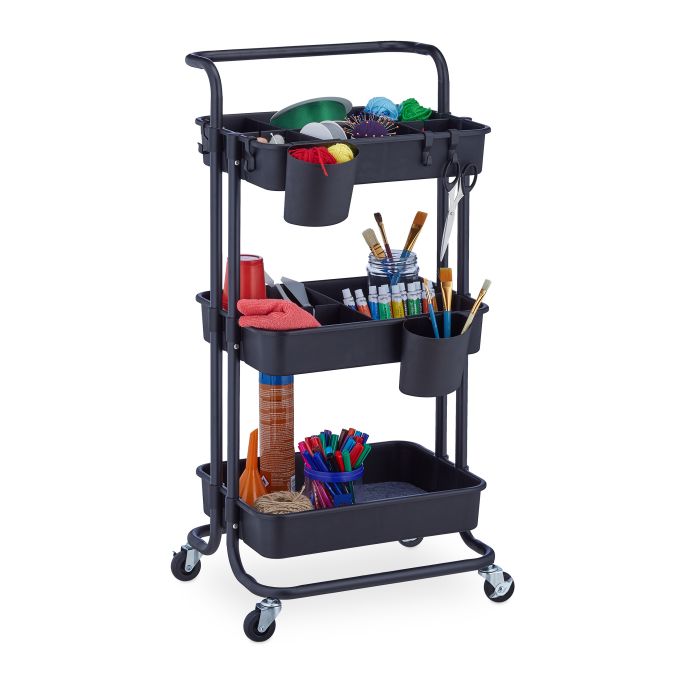
Kitchen carts: measure parking space, routes and storage
Choose a kitchen cart by checking where it will stand, how it will move and what it will hold. Compare usable shelf space, loads, casters and assembly requirements.
A basket cart can keep pantry items and utensils together. A cart with a top adds a surface, but that top is not automatically a cutting board or a suitable support for a hot or powered appliance. Check the permitted uses of the exact model.
Consider a fixed shelf if you do not need mobile storage and cannot leave a clear route for a cart. Folding carts need space both when open for use and when folded for storage.
Measure the parking space and the route separately
Record the clear width, depth and height where the cart will stand, including baseboards, pipes and countertop overhangs. Compare them with the complete assembled dimensions, including handles, casters and accessories. Shipping dimensions are not assembled dimensions.
Walk the planned route and check doorways, corners, thresholds and open cabinet or appliance doors. Removable tape can mark the footprint and help you check everyday access. It does not test how a loaded cart will steer or cross a threshold.
Parking space: clear dimensions and limiting obstructions.
Route: narrowest opening, corners and changes in floor level.
Working position: access to each shelf and nearby doors.
Product: assembled dimensions and whether they include all projections.
A small gap is not a fit guarantee
Hypothetical example: a 450 mm wide cart in a 460 mm opening leaves 10 mm in total, not on each side. That subtraction does not cover measurement uncertainty, a projecting handle or turning space. If you use inches, keep both sets of measurements in consistent units and do not round away a small clearance. Ask for the exact model's drawing when an essential dimension is missing.
Check your storage items too
Measure the largest item and compare it with the usable shelf area and clear height. Raised basket edges and uprights can restrict access. A bottle that stands between two shelves must also be reachable and removable.
Keep the load limit for each shelf separate from the whole-cart limit. Do not apply the total allowance to every basket or calculate a missing rating by adding assumed capacities. Check the manufacturer's conditions for load distribution and movement.
Casters, assembly and care
Confirm which casters swivel, which have brakes and how the brakes operate. Do not infer braking performance or stability from a photograph. Read the assembly sequence, maintenance requirements and permitted conditions of use.
If the cart will hold an appliance, check that appliance's installation and ventilation instructions as well as the cart's limits. Do not assume that the top permits direct food contact, cutting, heat or prolonged moisture. A critical condition that is not documented remains unresolved.
Keep a comparison record
For each exact variant, record the source and date, assembled dimensions, usable shelf area, shelf clearance, load limits, brakes, assembly requirements and missing information. Reject a documented conflict; leave the choice undecided when essential information is missing. The product cards show the published catalog for your selected store. This guide does not replace physical testing of stability or maneuverability.
Own editorial comparison method, without physical testing. Dimensions do not guarantee installation, stability or suitability for a particular use. Check the exact variant and its instructions. The numerical example is hypothetical.